Moving Beyond Destructive Path Flattening
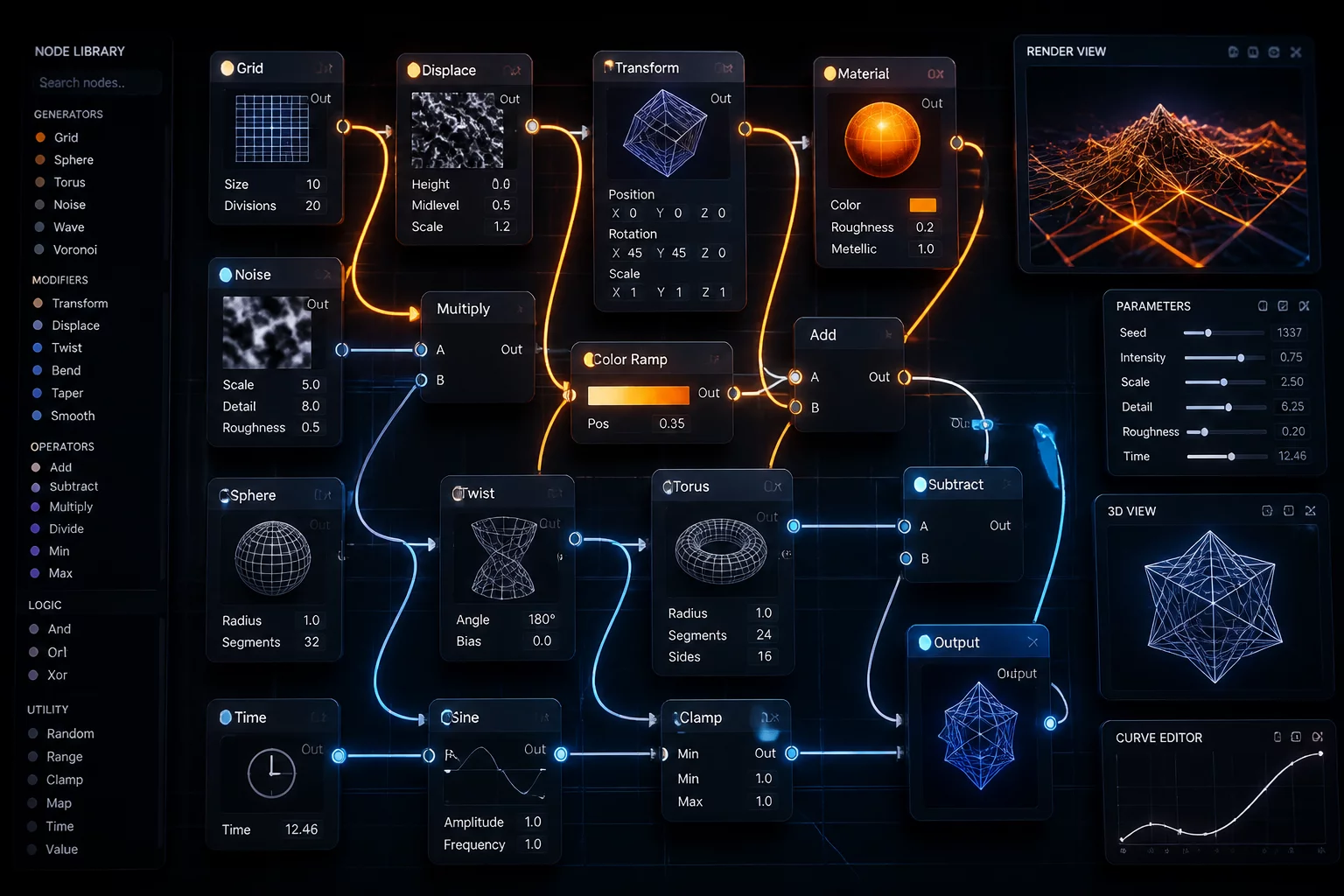
Traditional vector editors still treat paths as static coordinate arrays where every boolean merge or fillet operation discards the original source primitives. When design requirements shift late in a product cycle, designers face repetitive manual rebuilding. Graphite confronts this fragility directly by shifting 2D raster and vector illustration onto a fully procedural node architecture.
With the latest update, complex shapes, compound paths, and pattern distributions are defined as a graph of mathematical instructions. Modifying a parent radius or baseline curve instantly ripples downstream, preserving every fillet, stroke treatment, and clipping boundary without manual repositioning or destructive flattening.
Procedural graphs convert static drawings into living, reactive layout engines that preserve full editability from raw coordinates to final render.Marcus Thorne, SourceState Atelier Lead Technical Editor
Parametric Nodes and Live Evaluation Pipelines
Built from the ground up in Rust with native WebAssembly compilation, the software delivers continuous evaluation loops that rival dedicated 3D procedural tooling like Houdini, yet remains entirely lightweight inside the browser or desktop runtime.
Core Workflow Enhancements
This release introduces four crucial capabilities designed to solve long-standing maintenance bottlenecks in complex design systems:
- Live non-destructive booleans and path slicing with continuous parameter editing.
- Parametric array duplicators with mathematical distribution rules and noise fields.
- Direct data binding for dynamic icon resizing and variable stroke hierarchy adjustments.
- Granular node caching that isolates recalculations strictly to dirty graph nodes.
The Future of Systematized Vector Infrastructure
As design systems expand to support automated asset variations across multiple screen densities, device themes, and dynamic web applications, procedural toolsets like Graphite bridge the gap between static vector files and algorithmic generation. Teams can now treat vector assets as executable logic, eliminating maintenance overhead while ensuring pristine visual fidelity across all delivery targets.