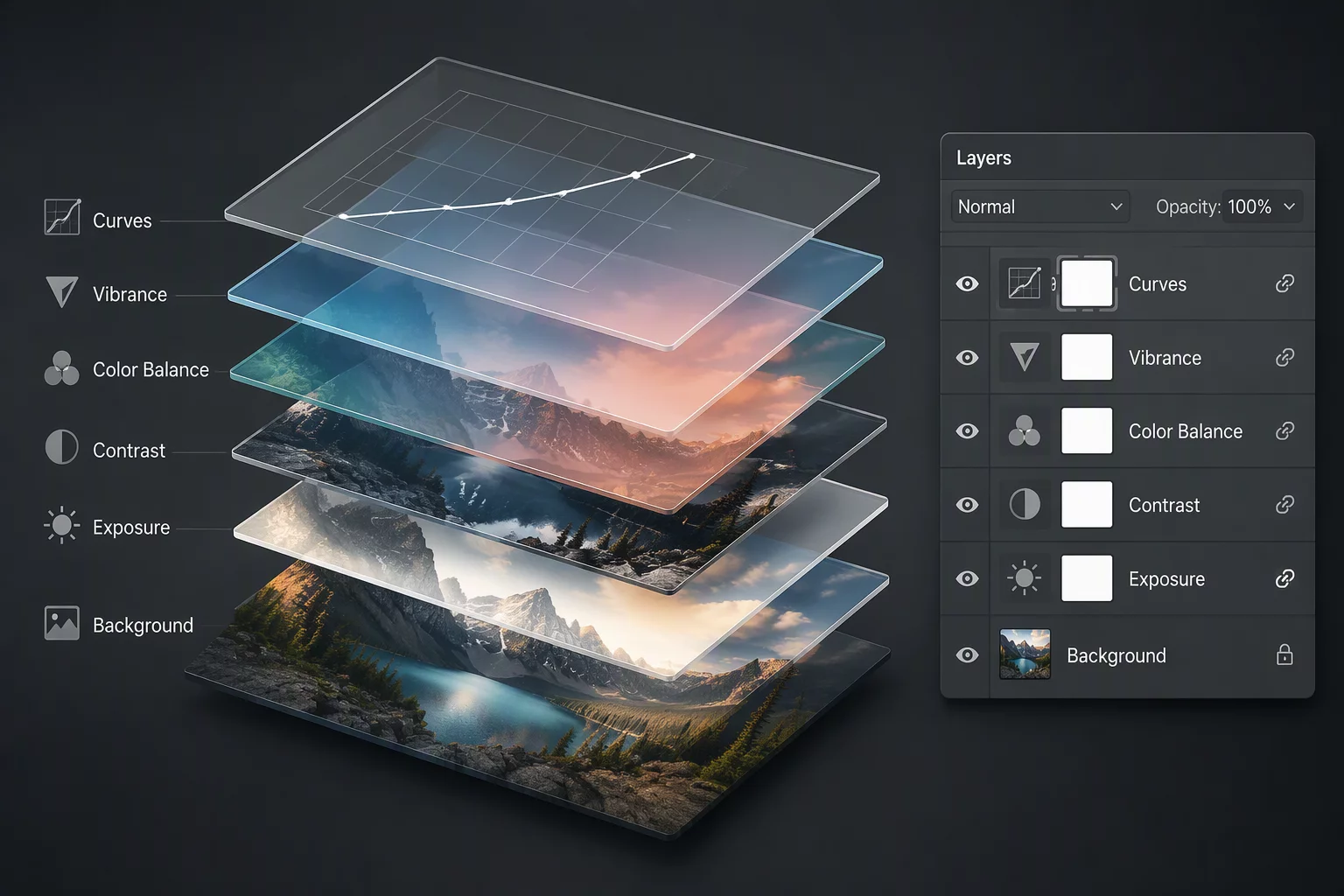
The Engineering Behind Lossless Raster Alterations
The modern raster pipeline has long struggled with balancing raw computing speed against the preservation of original source assets. In high-throughput digital production environments, destructive baking steps often degrade pixel fidelity and lock downstream workflows into rigid deliverables. The latest architectural update to Adobe Photoshop dismantles these compromises by introducing persistent mathematical evaluation nodes directly into the core compositing engine.
By isolating adjustment parameters as dynamic transform equations rather than raster pixel modifications, every single alteration remains completely fluid and reconfigurable across team handoffs. The system recalculates values at render time, ensuring that color shifts, channel curves, and exposure balances never bake artifacts into underlying image matrices.
"True editability in raster environments is achieved when every layer operation operates as an isolated function rather than a destructive transformation."— Sarah Jenkins, Lead System Architect at SourceState Atelier
Architectural Components of the Refined Layer Engine
Structuring layered files for maximum resilience requires an understanding of how adjustments cascade through the rendering hierarchy. When multiple non-destructive layers interact, their mathematical ordering determines dynamic range preservation and performance throughput.
Key Operational Criteria for Robust Adjustment Pipelines
Teams deploying structured editability workflows across enterprise asset libraries should adhere to several foundational rules:
- Anchor tonal hierarchies with 32-bit linear floating-point curves to eliminate banding in highlight recovery.
- Maintain isolated smart object references for source imagery to ensure base pixel immutability.
- Decouple luminance masking nodes into independent, reusable channel paths.
- Standardize layer naming conventions and adjustment parameters against design token definitions.
Long-Term Sustainability and Asset Interoperability
Transitioning to fully non-destructive adjustment architectures reduces file debt and accelerates cross-tool interoperability. When design files maintain clean layer semantics and parametric parameters, upstream creative decisions translate effortlessly into production pipelines, automated batch processing scripts, and modern design system distribution models.